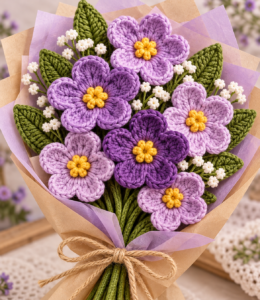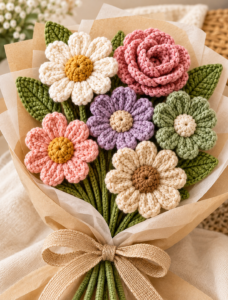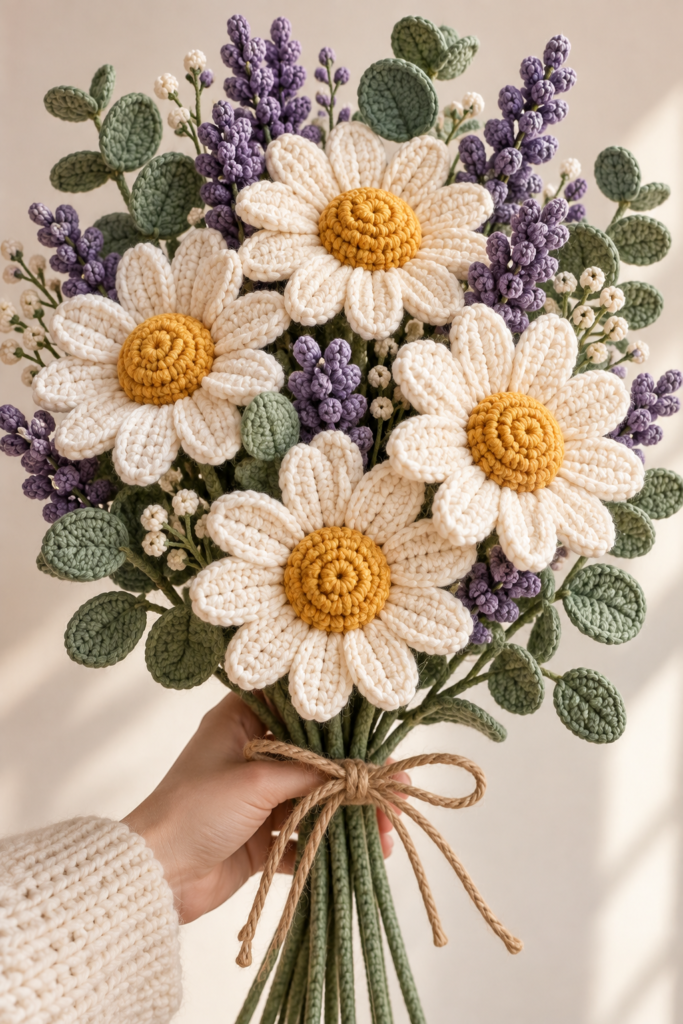
If you love handmade flowers that stay beautiful all year, these Easy Crochet Flower Bouquet Ideas for Beginners are a lovely project to try. Crochet bouquets can combine daisies, lavender, eucalyptus leaves, tulips, roses, and other simple flowers to create arrangements for home decor, handmade gifts, weddings, or spring decorations.
The bouquet in the inspiration image combines creamy white daisies with golden centers, delicate purple lavender stems, and muted sage-green foliage. The natural colors and simple twine bow give the arrangement a soft cottage-style look.
Below are 7 crochet flower bouquet ideas, with practical crochet instructions for making the flowers, leaves, stems, and other important pieces.
Crochet Abbreviations
MR = Magic Ring
ch = Chain
sc = Single Crochet
hdc = Half Double Crochet
dc = Double Crochet
tr = Treble Crochet
inc = Increase
sl st = Slip Stitch
st/sts = Stitch/Stitches
FO = Fasten Off
1. Daisy and Lavender Crochet Bouquet
This first bouquet is inspired by the reference image. It combines large white daisies, smaller purple lavender stems, and sage-green leaves.
For a medium bouquet, make approximately 4 daisies, 6–8 lavender stems, and several leafy branches.
Materials
- White cotton yarn
- Golden yellow yarn
- Lavender or purple yarn
- Sage or olive-green yarn
- 2.5–3.5 mm crochet hook
- Yarn needle
- Scissors
- Stitch markers
- Floral wire or another suitable craft stem support
- Green floral tape
- Fiberfill if needed
- Natural jute twine
Crochet Daisy Center
Using yellow yarn:
R1: 6 sc in MR (6)
R2: inc × 6 (12)
R3: (1 sc, inc) × 6 (18)
R4: sc around (18)
FO, leaving a long tail.
The slightly raised center gives the daisy more dimension than a completely flat circle.
Daisy Petals
Join white yarn to one stitch of the yellow center.
For each petal:
ch 7
Starting in the second chain from the hook:
sl st, sc, hdc, 2 dc, hdc
Sl st into the next available stitch of the yellow center.
Repeat around until you have approximately 9 petals distributed evenly around the flower.
FO and weave in the ends.
Gently shape the petals with your fingers.
Daisy Backing
Using green:
R1: 6 sc in MR (6)
R2: inc × 6 (12)
R3: (1 sc, inc) × 6 (18)
FO.
Place this circle against the back of the flower and sew around the edge, leaving the center accessible for the stem.
Daisy Stem
Attach the flower securely to a craft stem support.
Wrap green yarn or floral tape from just beneath the flower all the way down the stem.
Keep the wrapping tight and even.
Repeat the complete daisy tutorial to create four daisies for the bouquet.
Crochet Lavender Flower
The lavender stems should be long and narrow, with many small purple buds running along the upper portion.
Green Base
Using green yarn:
ch 28
Starting in the second chain:
27 sl st
This creates a narrow foundation for the lavender.
Purple Lavender Buds
Join purple yarn near the top.
For each small bud:
ch 4
Starting in second chain:
sl st, sc, hdc
Sl st back into the green foundation.
Move down approximately 1–2 stitches and repeat.
Alternate the buds from side to side rather than placing every bud in exactly the same direction.
Continue for roughly the upper two-thirds of the stem.
Leave the lower section green.
Make several lavender stems at different heights to give the bouquet a more natural shape.
Sage Leaf
Using sage green:
ch 9
Starting in the second chain:
sl st, sc, hdc, dc, dc, hdc, sc, sl st
Now work along the opposite side of the foundation chain:
sl st, sc, hdc, dc, dc, hdc, sc, sl st
FO.
This creates a simple oval leaf with a slightly pointed tip.
Make several leaves and attach them in pairs along green stems.
Assemble the Bouquet
Place the four daisies at slightly different heights.
Insert the taller lavender stems between and behind the daisies. Add the leafy branches around the outer edges to widen the arrangement.
Gather all stems together and wrap the lower section securely with green yarn or floral tape.
Finish with a natural jute bow for the rustic appearance seen in the inspiration image.
2. Beginner Crochet Tulip Bouquet
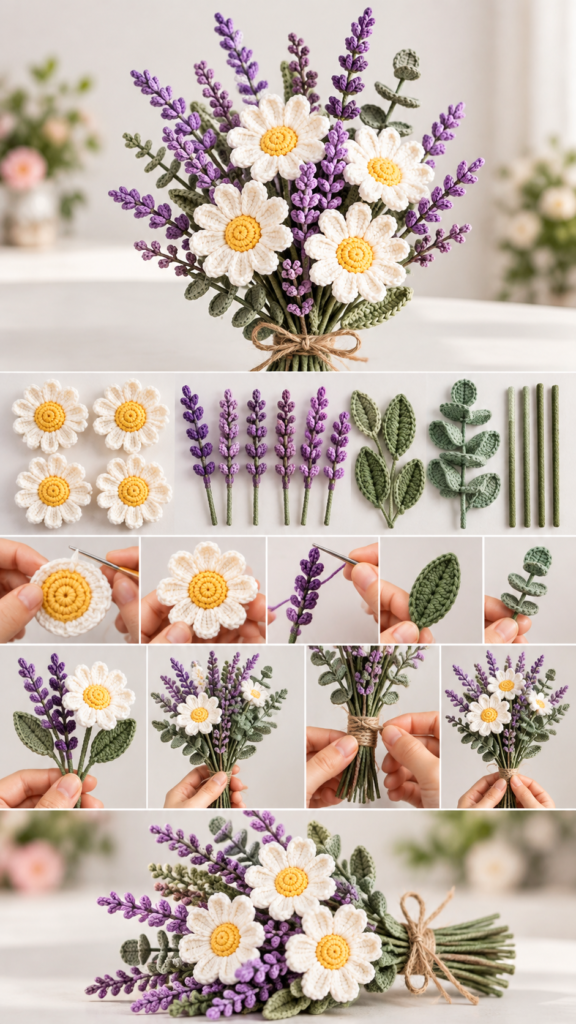
Tulips are an excellent beginner flower because the basic flower uses a simple cup shape rather than many individual petals.
Try soft pink, cream, lavender, and yellow tulips for a spring bouquet.
Tulip Flower
Using your flower color:
R1: 6 sc in MR (6)
R2: inc × 6 (12)
R3: (1 sc, inc) × 6 (18)
R4: (2 sc, inc) × 6 (24)
R5–R9: sc around (24)
Do not close the flower normally.
Flatten the opening slightly.
Pinch two opposite sides together and add a small stitch. Rotate the flower and bring the remaining sides toward the center.
Sew these points together to form the recognizable closed tulip shape.
Tulip Leaf
Using green:
ch 18
Starting in second chain:
sl st, sc, hdc, dc, 9 tr, dc, hdc, sc, sl st
Work down the opposite side:
sl st, sc, hdc, dc, 9 tr, dc, hdc, sc, sl st
FO.
The long narrow shape resembles a tulip leaf.
Stem
Attach the tulip to a supported green stem.
Wrap the stem with floral tape or green yarn and position one long leaf along the lower half.
Make 5–7 tulips in complementary colors and arrange them at slightly different heights.
3. Simple Crochet Rose Bouquet
A crochet rose can look detailed while still using a relatively simple construction method.
Rose
Using pink, cream, red, peach, or another flower color:
ch 45
Row 1
Starting in the second chain:
sc across (44)
Row 2
Turn.
Work:
(5 dc in next st, sl st in next st)
Repeat across the row.
This creates a long strip of scalloped petals.
FO, leaving a long sewing tail.
Shape the Rose
Starting from one end, roll the strip tightly for the center.
Continue rolling more loosely as the flower becomes larger.
Use the long yarn tail to sew through the bottom layers several times so the rose cannot unravel.
Rose Sepal
Using green:
R1: 5 sc in MR (5)
For each sepal point:
ch 5
Starting in second chain:
sl st, sc, hdc, sc
Sl st into the next base stitch.
Repeat five times.
FO.
Sew the green sepal beneath the rose.
Rose Leaf
ch 10
Starting in second chain:
sl st, sc, hdc, dc, tr, dc, hdc, sc, sl st
Repeat down the opposite side of the chain.
FO.
Make several roses with different shades and combine them with green leaves.
4. Crochet Sunflower Bouquet
Sunflowers create a cheerful bouquet and provide excellent practice with repeated petals.
Sunflower Center
Using dark brown:
R1: 6 sc in MR (6)
R2: inc × 6 (12)
R3: (1 sc, inc) × 6 (18)
R4: (2 sc, inc) × 6 (24)
FO.
Yellow Petals
Join yellow yarn.
For each petal:
ch 6
Starting in second chain:
sl st, sc, hdc, dc, hdc
Sl st into the next stitch on the center.
Repeat around.
For a fuller sunflower, add a second layer of petals behind the first.
Sunflower Back
Using green:
R1: 6 sc in MR
R2: inc × 6 (12)
R3: (1 sc, inc) × 6 (18)
R4: (2 sc, inc) × 6 (24)
FO.
Sew behind the sunflower.
Large Leaf
Using green:
ch 12
Starting in second chain:
sl st, sc, hdc, dc, 3 tr, dc, hdc, sc, sl st
Continue down the opposite side in reverse order.
Make 5–7 sunflowers and arrange them with several large green leaves.
5. Mini Daisy Crochet Bouquet
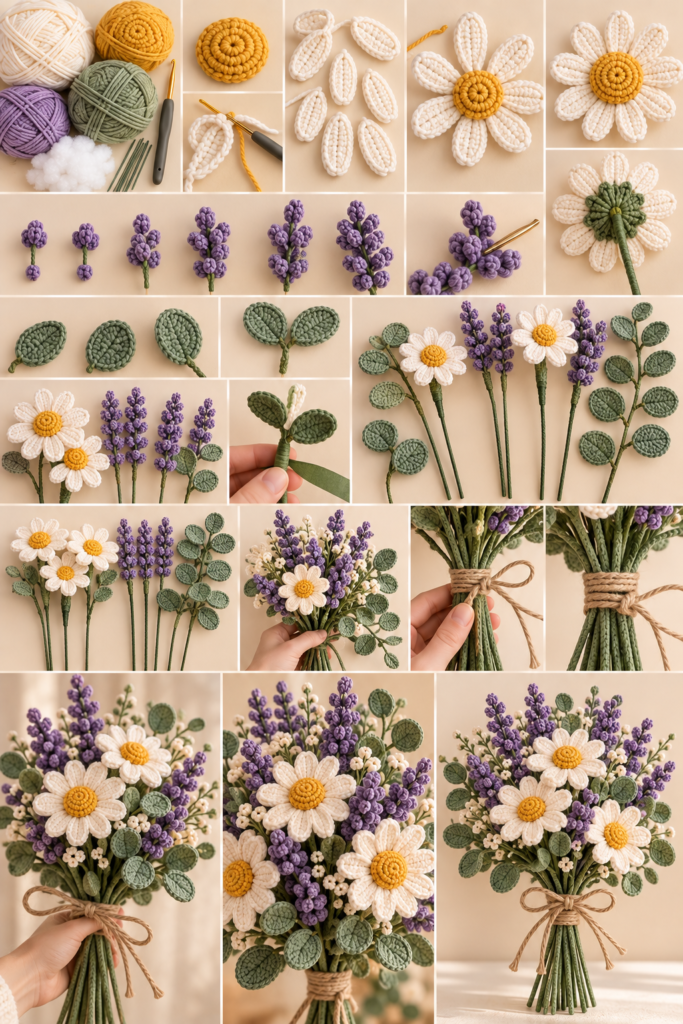
This version uses smaller daisies and works beautifully as a small decorative bouquet.
Mini Daisy Center
Using yellow:
R1: 6 sc in MR
R2: inc × 6 (12)
FO.
Mini Petals
Join white.
For every petal:
ch 5
Starting in second chain:
sl st, sc, hdc, sc
Sl st into the next stitch of the center.
Repeat until the flower looks full.
FO.
Mini Leaves
With green:
ch 7
Starting in second chain:
sl st, sc, hdc, hdc, sc, sl st
Repeat on the opposite side.
Create 7–10 mini daisies rather than only a few large flowers.
Place the tallest flowers in the middle and gradually shorten the outer stems.
This creates a rounded bouquet shape.
6. Lavender and Eucalyptus Crochet Bouquet
You can also skip large flowers completely and create a delicate botanical arrangement using lavender and eucalyptus.
Lavender
Follow the lavender tutorial from Bouquet 1, but make stems in three different lengths.
For example, make:
- 3 tall lavender stems
- 4 medium stems
- 3 shorter stems
Use two slightly different shades of purple for more depth.
Round Eucalyptus Leaf
Using muted green:
R1: 6 sc in MR (6)
R2: inc × 6 (12)
R3: (1 sc, inc) × 6 (18)
FO.
Fold the circle slightly at the bottom while attaching it to the stem. This prevents the leaves from looking completely flat.
Small Eucalyptus Leaf
R1: 6 sc in MR
R2: inc × 6 (12)
FO.
Alternate larger and smaller leaves along the stem.
Arrange the eucalyptus behind the lavender to create a soft, airy bouquet.
7. Mixed Cottage Garden Crochet Bouquet
For the final idea, combine several flowers into one colorful handmade bouquet.
Use:
- 3 daisies
- 2 roses
- 2 tulips
- 4 lavender stems
- Several sage or eucalyptus branches
You can follow the individual flower instructions above instead of learning an entirely new construction.
Suggested Color Palette
Use:
Cream for daisies
Mustard yellow for centers
Dusty pink for roses
Soft lavender for tulips
Purple for lavender
Sage green for foliage
Bouquet Arrangement
Begin with the largest flowers.
Place the daisies and roses around the central area, but avoid positioning everything at exactly the same height.
Add tulips slightly behind them.
Next, insert tall lavender stems into empty spaces.
Use eucalyptus and sage leaves around the outer edges and between flowers.
Rotate the bouquet while arranging it so it looks balanced from several angles.
Finally, gather all the stems and secure them together.
Wrap the center with jute twine, ribbon, or crocheted cord.
How to Make Crochet Flower Stems
A beautiful crochet flower needs a stem that can support its weight.
After finishing your flower, secure it to a suitable craft stem support. Begin directly underneath the flower and wrap green floral tape or yarn tightly around the stem.
When adding leaves, position them against the stem while wrapping so the wrapping helps hold them in place.
For bouquets, vary the stem lengths slightly. Identical stem heights can make an arrangement look very flat.
Keep taller flowers toward the center or back and shorter flowers near the front and outer edges.
How to Make a Simple Crochet Stem Cover
If you prefer a more crocheted finish rather than visible floral tape, you can create a narrow green cord.
Using green yarn:
ch 35–50, depending on your required stem length.
Starting in the second chain:
sl st across
FO.
Wrap or stitch the narrow crochet cord around your supported stem.
Best Yarn for Crochet Flower Bouquets
Cotton yarn is one of the easiest options for crochet flowers because it provides clear stitch definition and helps petals and leaves maintain their shape.
Lightweight cotton also works particularly well for lavender and other delicate botanical details.
For a bouquet similar to the inspiration image, choose slightly muted rather than extremely bright colors.
Creamy white, mustard yellow, lavender purple, olive green, and sage green create a beautiful natural palette.
Beginner Tips for Crochet Flowers
Start with daisies if this is your first crochet bouquet. Their construction is repetitive, which makes it easier to understand how crochet petals are formed.
Keep your tension consistent across every petal. Uneven tension can make some petals noticeably longer than others.
When making several identical flowers, complete each component in batches. For example, crochet all four yellow centers first and then make the white petals.
Shape the petals and leaves with your fingers after finishing them.
Do not arrange the bouquet until all the flowers and greenery are complete. This gives you more freedom to experiment with placement.
Avoid making every stem exactly the same length. Natural flowers grow at different heights, and the same principle makes a crochet bouquet look fuller.
Frequently Asked Questions
Are crochet flowers suitable for beginners?
Yes. Daisies, tulips, simple roses, and basic leaves can all be made using common beginner stitches such as chains, single crochet, half double crochet, and double crochet.
What is the easiest crochet flower to start with?
A simple daisy is an excellent first project because the center is small and the same petal construction can be repeated around it.
How many flowers do I need for a crochet bouquet?
It depends on the size of the flowers and the fullness you want. A small bouquet may use 5–7 main flowers, while greenery and small filler flowers help make the arrangement look fuller.
How do I keep crochet flowers standing upright?
The flowers need enough internal stem support to hold their weight. Wrap the support carefully with green floral tape, yarn, or a crocheted stem covering.
Can I make a bouquet without floral wire?
For decorative crochet flowers, another firm craft-safe stem support can be used. Choose something appropriate for the intended use and ensure any rigid ends are completely covered.
Which colors work best for a spring crochet bouquet?
Cream, white, pale yellow, blush pink, lavender, peach, and mint or sage green create a soft spring palette.
Final Thoughts
These Easy Crochet Flower Bouquet Ideas for Beginners give you plenty of ways to create flowers that can be displayed throughout the year.
If you want to recreate the feel of the inspiration image, start with the first bouquet: make four creamy white daisies with golden centers, surround them with several purple lavender stems, add plenty of sage-green foliage, and finish the stems with natural jute twine.
Once you learn the basic flowers, you can mix daisies, roses, tulips, sunflowers, lavender, and eucalyptus to create your own unique crochet bouquet.