1. Introduction: A Love Letter to the Croissant
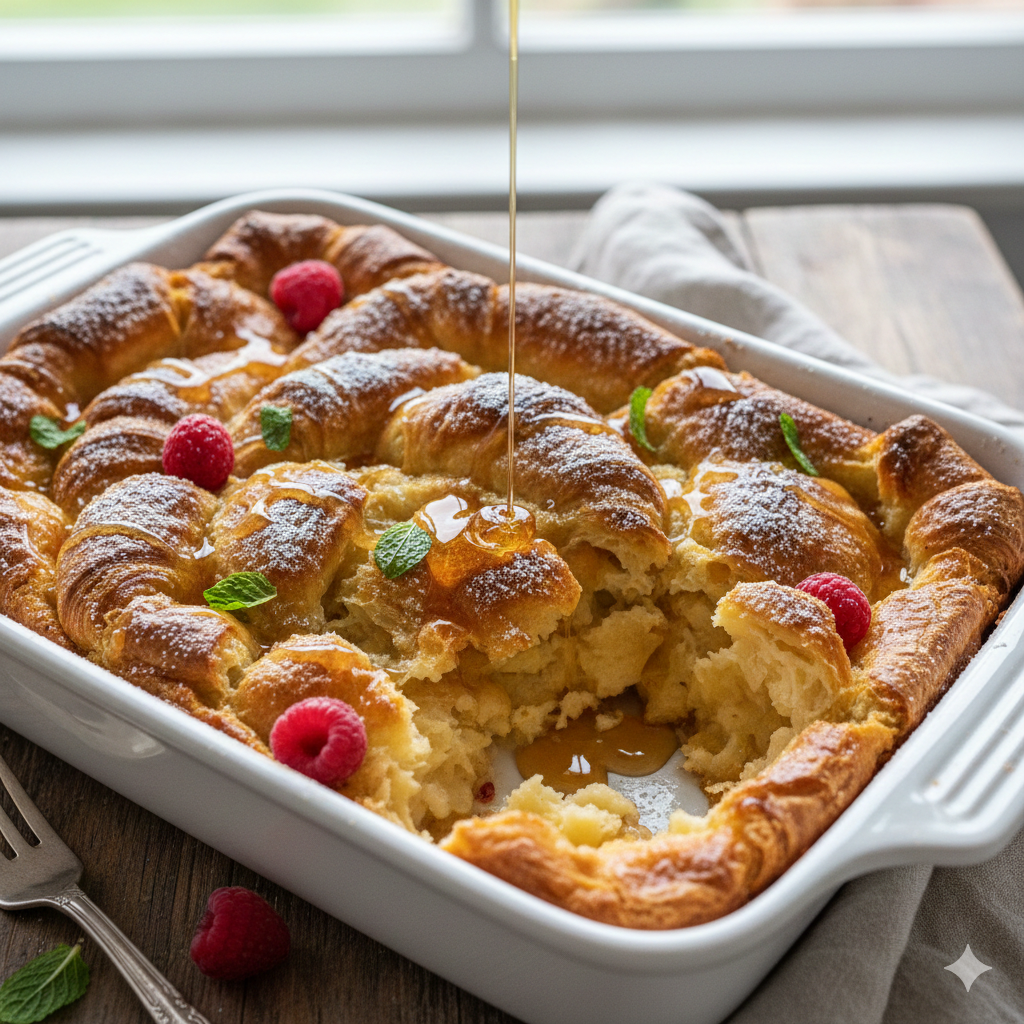
There is a specific kind of magic that happens when the flaky, laminated layers of a French croissant meet the rich, velvety embrace of a vanilla-scented custard. If standard French toast is a reliable morning companion, the Croissant French Toast Bake is its sophisticated, slightly indulgent cousin who just arrived from a Parisian patisserie.
The beauty of this dish lies in its texture. Unlike traditional sliced bread, which can sometimes become soggy or one-dimensional, croissants are engineered with “honeycomb” air pockets. When soaked and baked, these pockets trap the custard, creating a contrast between a pudding-like center and golden, shattered-glass crispiness on top.
This recipe traces its spiritual roots to Pain Perdu—literally “lost bread.” Historically, French bakers used this method to resurrect day-old, stale bread. By using buttery croissants instead of a rustic loaf, we transform a humble “rescue mission” into a centerpiece-worthy feast. Whether you are hosting a festive holiday morning or simply want to turn a quiet Sunday into an event, this bake is the ultimate shortcut to a gourmet experience.
2. Recipe Overview
- Cuisine Type: French-American Fusion
- Difficulty Level: Easy/Intermediate
- Prep Time: 20 minutes
- Soaking Time: 30 minutes (up to 12 hours)
- Cook Time: 35–45 minutes
- Total Time: Approx. 1 hour 35 minutes
- Dietary Classifications: Vegetarian (Contains dairy, eggs, and gluten)
3. Equipment and Tools
To achieve the perfect bake, you’ll need the following kitchen essentials:
- Baking Dish: A 9×13 inch (approx. 23×33 cm) ceramic or glass casserole dish. Deep-dish styles are preferred to prevent custard overflow.
- Large Mixing Bowl: For whisking the custard base.
- Whisk: A sturdy balloon whisk to ensure the eggs and dairy are fully emulsified.
- Measuring Cups & Spoons: For both liquid and dry ingredients.
- Aluminum Foil: To cover the dish if the tops brown too quickly.
- Serrated Knife: To cleanly slice the croissants without crushing the delicate layers.
4. Serving Suggestions
Plating Recommendations
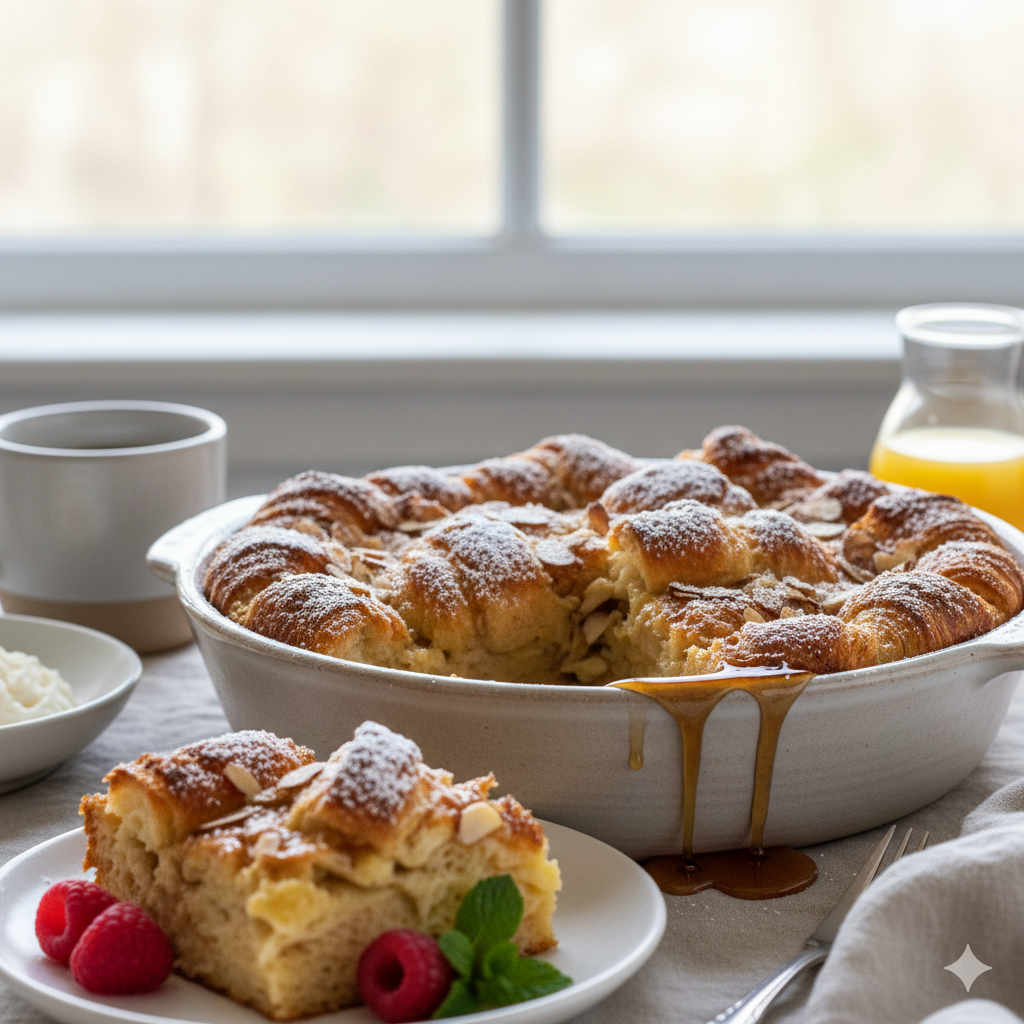
Serve a generous rectangular scoop while warm. The steam carries the aroma of nutmeg and butter beautifully.
Garnish Ideas
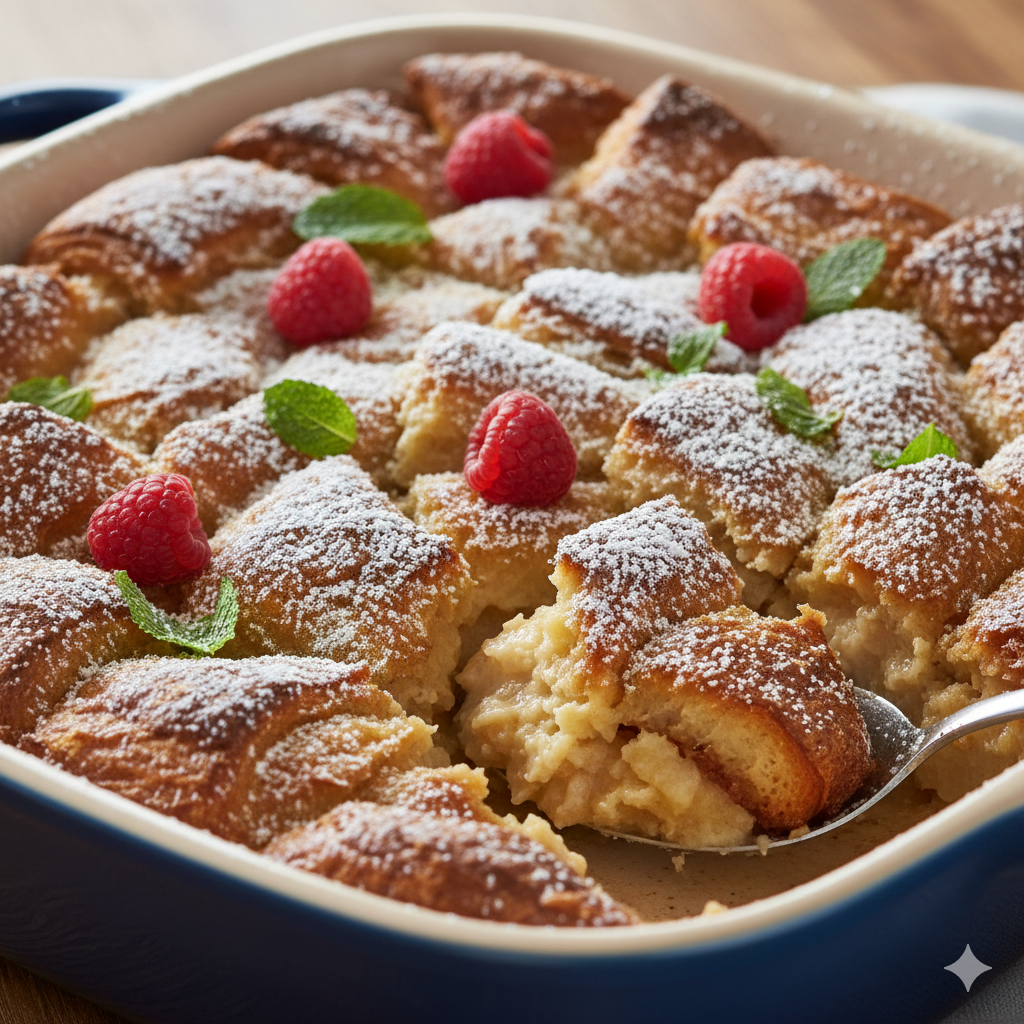
- A heavy dusting of powdered sugar (confectioners’ sugar).
- Hand-torn fresh mint leaves for a pop of color.
- A handful of fresh raspberries or sliced strawberries.
Complementary Sides
Balance the sweetness with salty, savory sides:
- Thick-cut smoked bacon or maple breakfast sausages.
- A simple arugula salad with a lemon vinaigrette to cut through the richness.
Beverage Pairings
- Coffee: A dark roast espresso or a creamy latte.
- Cocktail: A classic Mimosa or a crisp Peach Bellini.
- Non-Alcoholic: Freshly squeezed orange juice or sparkling cider.
5. Nutritional Information (Per Serving)
Note: Based on 8 servings.
| Nutrient | Amount |
| Calories | 480 kcal |
| Total Fat | 28g |
| Saturated Fat | 16g |
| Cholesterol | 185mg |
| Sodium | 320mg |
| Total Carbohydrates | 44g |
| Dietary Fiber | 1g |
| Sugars | 18g |
| Protein | 12g |
Health Note: This dish is a high-energy, indulgent treat. For a lighter version, you can substitute whole milk with almond milk, though the custard will be less stable.
6. Storage and Reheating
Refrigeration
Store leftovers in an airtight container in the fridge for up to 3 days.
Freezing
You can freeze the baked casserole. Wrap individual portions in plastic wrap and then foil. Freeze for up to 2 months. Thaw in the refrigerator overnight before reheating.
Reheating
- Oven (Best): Place in a 350°F (175°C) oven for 10–15 minutes until the edges crisp up again.
- Microwave: 45–60 seconds. It will be soft but still delicious.
7. Expert Tips and Variations
Professional Tips
- Stale is Better: Use croissants that are 1–2 days old. They absorb the custard better without falling apart.
- The “Push” Test: After pouring the custard over the croissants, gently press them down with your hands to ensure every nook and cranny is submerged.
- Room Temp Eggs: Use room-temperature eggs for a smoother, more even custard.
Creative Variations
- Chocolate Hazelnut: Spread a layer of Nutella inside the halved croissants before baking.
- Savory Twist: Omit the sugar and vanilla. Use heavy cream, Gruyère cheese, chives, and ham for a “Monte Cristo” style bake.
- Citrus Zest: Add the zest of one orange to the custard for a bright, floral aroma.
8. Ingredients Section
The Custard Base
- 6-8 Large Croissants: Preferably “day-old” (store-bought or bakery).
- 5 Large Eggs: Grade A, room temperature.
- 1 ½ cups (355ml) Whole Milk: Provides the essential structure.
- 1 cup (240ml) Heavy Cream: For that signature silken mouthfeel.
- ½ cup (100g) Granulated Sugar: Adjust to your sweetness preference.
- 1 tbsp Pure Vanilla Extract: Don’t skimp on quality here!
- 1 tsp Ground Cinnamon: For warmth.
- ¼ tsp Ground Nutmeg: Adds a professional depth of flavor.
- ¼ tsp Salt: To balance the sugars.
The Topping (Optional but Recommended)
- 2 tbsp Sliced Almonds: For crunch.
- 1 tbsp Brown Sugar: For caramelization.
9. Step-by-Step Instructions
Step 1: Prepare the Croissants
Using a serrated knife, slice the croissants into large chunks (about 2–3 pieces per croissant). You can also simply split them in half lengthwise. Grease your 9×13 baking dish with butter.
Step 2: Arrange the Dish
Place the croissant pieces into the prepared dish. Overlap them slightly so they look like “shingles.” This creates high points that will get crunchy in the oven while the bottoms stay soft.
Step 3: Whisk the Custard
In a large mixing bowl, crack the 5 eggs and whisk until combined. Add the whole milk, heavy cream, sugar, vanilla, cinnamon, nutmeg, and salt. Whisk vigorously for 1–2 minutes until the sugar is dissolved and the mixture is pale yellow.
Step 4: The Soak
Slowly pour the custard over the croissants, making sure to hit every piece. Use a spatula or your clean hands to gently press the croissants down so they soak up the liquid.
Chef’s Note: Let it sit for at least 30 minutes. For the best flavor, cover with plastic wrap and refrigerate overnight.
Step 5: Preheat and Top
When ready to bake, preheat your oven to 350°F (175°C). If refrigerated, let the dish sit on the counter for 15 minutes to take the chill off. Sprinkle the sliced almonds and brown sugar over the top.
Step 6: The Bake
Bake for 35 to 45 minutes.
- Visual Cues: The bake should be puffed up (like a soufflé) and the tops should be a deep golden brown.
- The Jiggle Test: Give the pan a gentle shake. The center should have a slight “wobble” but shouldn’t be liquid.
Step 7: The Rest
This is the hardest part! Let the bake rest for 5–10 minutes. This allows the custard to set so you get clean slices.
10. Frequently Asked Questions (FAQ)
Q: Can I use low-fat milk?
A: You can, but the result will be less creamy. The fats in whole milk and heavy cream are what give the dish its “custard” texture. If you use skim milk, the bake may end up more “watery.”
Q: My croissants are browning too fast! What do I do?
A: Every oven is different. If the tops look dark but the center is still liquid, loosely tent the dish with aluminum foil for the final 15 minutes of baking.
Q: Can I add fruit?
A: Absolutely! Fresh blueberries or blackberries are wonderful. Toss them in with the croissant pieces before pouring the custard.
Q: What if I don’t have a 9×13 dish?
A: A large oval gratin dish or even two smaller 8×8 square pans will work. Just keep an eye on the bake time, as thinner layers cook faster.
Q: Why is my French toast bake soggy?
A: This usually happens if the croissants were too fresh/soft or if the bake didn’t stay in the oven long enough. Ensure the center reaches an internal temperature of roughly 160°F (71°C).